Re: Operator Variables in Logical Graphs • 6
A funny thing just happened. Let’s see if we can tell where. We started with the algebraic expression 


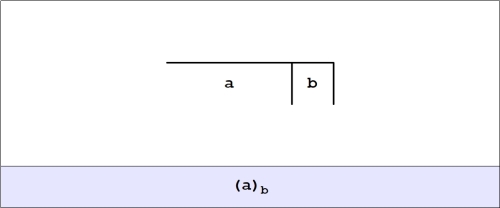
What happened here is this. Our contemplation of a constant operator as being potentially variable gave rise to the contemplation of a newly introduced but otherwise quite ordinary operand variable, albeit in a newly-fashioned formula. In its interpretation for logic the newly formed operation may be viewed as an extension of ordinary negation, one in which the negation of the first variable is controlled by the value of the second variable.
We may regard this development as marking a form of controlled reflection, or a form of reflective control. From here on out we’ll use the inline syntax 

- The Entitative Interpretation
for which
and
calls this operation logical equality. - The Existential Interpretation
for which
and
calls this operation logical difference.
 for which
  and
and 
 for which
  and
and 
cc: FB | Logical Graphs • Laws of Form • Mathstodon • Academia.edu
cc: Conceptual Graphs • Cybernetics • Structural Modeling • Systems Science





/fit-in/580x348/filters:format(webp)/english-betterindia/media/media_files/2026/08/04/5-2026-08-04-18-31-45.png)

/pic9729642.png)